

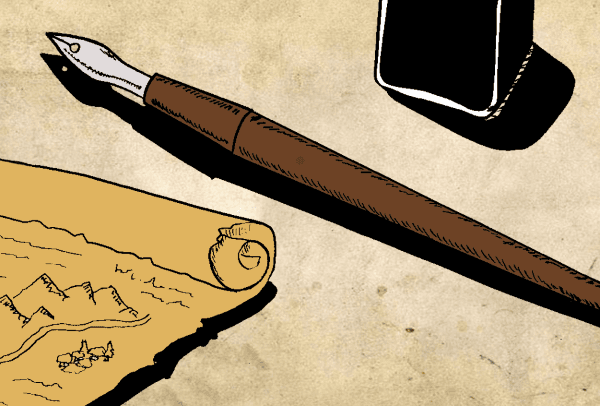
 In high school and college, I wanted to learn how to draw like Walter Simonson. He was one of the most influential comic book artists of the 80’s, and continues to draw to this day. In an interview or on a letters page, he revealed that he did all of his inking using a Hunt 107 ink nib. These are those little metal tips that artists use to ink cartoons and comics; the descendants of the quill pen.
However, owning the same pen as Walt Simonson didn’t improve the quality of my drawing and inking overnight. That took a great deal of drawing and painting. There was no magic equipment that did it for me. Only time and practice helped, and the process of improvement is ongoing.
So what does all this have to do with being a GM?
There’s No Magic Purchase
If you’re like me, you spend a lot of time thinking about what new systems. Will they work better than the one you are currently using? You might even get caught up in upgrading when a new edition of your favorite game is released. Certainly it is good to try other systems and see what else is available. However, it can end up consuming some creative energy that might be better spent in other ways. Like the Hunt 107, there is no guarantee that a new system or new edition will make you a better GM.
The same goes for minis, maps, and terrains. They are nice to have, but sometimes their pursuit can be a distraction. I think  “if only I had “X”, my games would be that much better.” We can all certainly improve our DM-ing, but not generally through purchases.
You Don’t Need Much
Along with a nib pen, I need paper, pencils, ink, and a few other basic tools to draw. Under twenty bucks easily. The same thing goes for roleplaying games. You probably already own more game systems than you will ever play, and there are plenty of free starter rules, rules systems, and retroclones online. You can easily print tokens and maps for free using the internet. To plan a fun adventure, you just need a copy of the rules and a notebook (paper or virtual). Need inspiration? There are more adventures and adventure generators online than you can ever play. Just tweak them and make them your own. You have everything you need at your fingertips or in your house.
So I Shouldn’t Buy Anything?
Buy what you like. Enjoy the hobby. Like the Hunt 107, get the tools that will help you improve. If you’ve played a particular system and think that it will give you better gaming, go for it.  If you think that a particular GM advice book may help you improve, by all means get it.
I’m only suggesting that the distractions of the hobby can overwhelm your prep time (or mine, I’m preaching to myself too). Spend quiet time thinking about your next game, how you can improve it over your previous sessions. Do that, and it won’t matter quite so much which system/edition you are playing or whether you own fancy minis.
You may have some different perspectives than I took in this essay. Tell us below what you think.




There is no magic purchase but if the tool doesn’t work the way you do, you are fighting it as you try to work. When considering a new tool, ask yourself: What is the cheapest way I can try this? Once you try it a few times, you’ll know if the tool is right for you.
Also, learn the correct techniques for your tools. This is especially important when trying a new tool. Not doing it right can lead to frustration and rejection. Sometimes, just improving your technique can make a tool seem like magic. 🙂
I’ve fought tools before–it can be so annoying! I hate to spend money on something I don’t think I’ll use much, but that sometimes traps me into doing things the hard way for way too long.
I think its funny that despite being professional game cartographer, for my own games, unless I plan to run a 2 year campaign in a given world, I almost never create world maps, and very often our group use a white board with grid and marker to run encounters, because it works. If an encounter with combat takes a full hour to play, why spend 3 hours designing a map for a 1 hour or less encounter. An exception to that is if we are doing urban settings, then I need a detailed city map. But for most other situations, I almost never create maps for my own games. I generally create maps for publishers and their products or my own products. If I plan to sell it, I map it, but if just for me, I usually never do…
The best game masters are the ones who’ve put in hours and hours on their craft. You can give the best setting, system, and gaming stuff to a novice game master and it won’t make them great, they’ll just have a lot of cool tools.
In the shooting world, it’s the shooter, not the gun, that hits the target.