

We recently got an email from a Gnome Stew reader, Shane Kirby (Shaninator here on the Stew), who is planning to open a gaming store in Alabama and wanted some feedback from fellow readers and GMs. He offered some good hooks for an article, and it’s a topic we’ve never covered here before, so we thought it might interest our readers.
Sure, it’s free market research, but it’s market research I wish gamers were consulted about more often, and it’s a topic I love to talk about myself.
Shane would also like some help naming his prospective store, and is offering a $100 Amazon gift certificate to the person who suggests the name he eventually chooses.
Sound good? Let’s dive in!
Observations
Shane has done his homework, and he’s identified some key features of a good local gaming store (LGS) — features that would help turn it into your favorite local gaming store, or FLGS:
1. Brick and mortar stores have the advantage of word of mouth. Knowledgeable staff is extremely important. When the store first opens, I will probably only have one other employee besides my wife and myself. I’m the type of gamer who plays and reads nearly everything, and I don’t limit myself to only Wizards of the Coast products. My wife is quickly catching up to me in her knowledge, too. As employees come in, I could see adding a section called “Employee Top Picks” to help showcase games that wouldn’t normally catch your eye.
2. Space. The best LGSs all have plenty of space to hold tournaments, war games, and allow gamers room to play without being bothered by CCG players.
3. Promotions. I’ve done my fair share of researching wholesale books and distributors. Many game stores get stuck in a rut and stick to their distributors, when the dealer should be trying to win your support. Too many games can now be bought directly from the publisher in the gaming industry as well. Getting products at good prices isn’t hard if you try, considering the markup on books in very high. Wholesale can lead to my customers reaping discounts and promotions, while I still make enough profit to stay afloat or expand.
Another good promotion would be using membership cards, probably punch cards when we first open. After 10 visits, you receive a free product or discount on your next visit. GMs and tournament judges would have access to a different membership that rewards running games in the store as well as making purchases.
4. Organization. I hate looking for books at my only LGS in the area because it’s not well-organized. In fact, finding a book is like digging for treasure, except without the happy ending when I realize the store is out of stock. Organize the store by system, so fans of White Wolf can jump past Mutants & Masterminds, for example.
5. A side gig. Aside from the main store, I’m beginning to write my first supplement. I will promote this in the store, along with free adventures and other supplements for GM memberships. I am focusing my writing on a system generic fantasy series called “Highwall.”
Are these all of the elements of a good LGS? What does it take to make your LGS an FLGS?
Questions for GMs
Based on what Shane said, I think there are two key questions here:
- What do GMs want out of their FLGSs, and how is that different from what players might want?
- How can brick-and-mortar stores help GMs in ways that online stores cannot?
Those are meaty questions, and along with more general gamer-oriented questions, they’re ones I wish more LGS owners would ask before opening their doors.
So how about it: Do GMs have different FLGS needs than players?
Name That Store!
Right now, Shane’s store has no name — and it needs one. If you’d like to give him a hand, suggest fun names in the comments. If he picks a name that you suggested (and were the first to suggest), he’ll send you a $100 Amazon gift certificate.
(Gnome Stew isn’t involved in this part of contest, and Shane is free to make this offer elsewhere, too. We’ll pass on the winner’s email address to Shane, assuming the winner is a Gnome Stew commenter.)
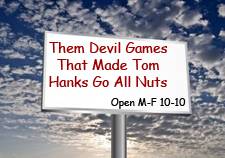
Can you do better than my current favorite, “Them Devil Games That Made Tom Hanks Go All Nuts”?








Good luck Shane. I wish there was a gaming place near by where I live. Actually, starting a game shop has been a distant (but perhaps unrealistic at least for now) dream of mine.
“Them Devil Games That Made Tom Hanks Go All Nuts�
I like it, but it’s a tad long. Hmm.
My ideas off the top of my head:
* The Monster’s Maze
* Dragon’s Nest
* Minotaur’s Labyrinth (So great, it’s impossible to leave! 🙂 )
* Fate’s Dice
* Ludorium
* Ludoria
Not very good ones, but I might be able to come up with better tomarrow.
I’ve always wanted to run my own store (as opposed to other peoples)
I’d like to suggest
DiceMonster
FLAGS (Friendly Local Alabama Gaming Store)
Nerdville
Good Luck, Shane.
I’d personally take advantage of the nicknames that kind of store has, and just call it FLGS (or FLAGS as Whitt mentioned), or “Brick and Mortar.”
Additionally, if you’re as attached to your Highwall concept as the store itself, I think naming it Highwall Games would be interesting. I’d head down to Highwall and roll with some friends.
Dimension Door
Here are my suggestions:
* No dice, no rules, no play
* Gaming Geas
* Gamers Unite!
* Gamers Union
* Needy Gamers
* A Tarrasque ate my baby
* Wild Magic Zone
Aura of Fun
As a GM I remember times past when I often struggled to have a venue to run games, a store that has gaming space was always appreciated.
In my youth the FLGS was the only place to find info on games looking for players, these days the internet is there for us, but getting your store onto the social networks such as facebook or twitter would be a great way to draw in the same kind of meet ups that you got with the old pin board at the back of the store.
My FLGS uses a loyalty card system like the one you mentioned, ours rewards you with a stamp every time you spend £10. 10 stamps gives you a £10 off your next purchase.
I have other ideas to share but I’m at work… grin so here’s a few name suggestions.
Quests End
House of Games
Choose your own Adventure
Yellowhammer Games (?)
I strong appeal for me would be good theming. Dress up your store as a medieval castle, a dark cave, or a spaceship bridge. If at all possible, try to change this theme every once in a while (to promote certain products, for example).
Other than that, I can only suggest the obvious: organize plenty of events, workshops, game introduction sessions, with free handouts (lighter versions of certain rules, free dicesets or miniatures, …) That would work for me (I like to get to know new things inside and out before I actually buy them).
If i ever opened a gaming store, and I did want to for a long time 🙂
I would name it
“Games and Theory”
My suggestion for a name; “Natural 20”
The Tavern
The Den
If it’s close to Birmingham I’d have to visit. 🙂
I hate to suggest something so crass as to steal another store’s name, but my favorite gaming store name was “Your Move Games” in Somerville, MA.
It’s nice because it doesn’t use an in-reference to any one gaming system, even one as central to the hobby as D&D. “Your Move” doesn’t even limit itself to RPGs. It’s so much a part of every game you’ll sell that I feel like every customer hears it and thinks of his/her own favorite game.
Aside from what was said is required, stock is very important. For more than just RPGs, you need CCG/TCG, board games, war games, etc. You need to be well stocked. If you do not have something, let your customers order it through you- then have it in a timely manner.
Also- track everything, that day. It is very hard for game stores that sell things like minis and cards games to stay on top of their inventory and their receipts unless they stay on top of them from the start.
Another big thing for a LFGS is to be friendly. It is kind of a no brainer, but you need to almost go out of your way to be friendly. If the shop owner asks me what I’m looking for my answer is almost always, “just looking” and they leave it at that. Do not do this! You should see what games they play, tell them what you have of it, what you have of the same and different genres. Make a couple recommendations in their product of choice.
Store names- World of Gamecraft; Gamer’s Armory; Quest for Gaming; Gamer’s Trove.
-Just my commnet on names, try not to go too far into fantasy/sci-fi/rpg elements. Game stores sell a lot of different products and often make a lot of money outside RPGs, having a name that is likable and generic enough helps gamers think that there is something that they want no matter what their gaming medium is.
I’m not interested in most aspects of a FLGS. (And I’m totally backing up AlasseMages. Just call it FLGS) I don’t take advantage of the gaming space, I’m not all that into browsing the selection (unless it’s got a big selection of rotating old or misc stuff). Honestly, there are TWO reasons I go to a FLGS. Immediate gratification, and because I like the people there. Aside from keeping a stocked and varied inventory, you can’t do a hell of a lot about immediate gratification, but you CAN do you best to make sure that your customers not only like you, but your other customers. Make sure your employees understand that (within reason) your customers are their friends and to be treated as such, and make efforts to introduce customers that have similar interests. “Have you met Frank? He runs Star Wars too.” Have events that, while gaming events, are also designed for quick chair rotation so that customers have the opportunity to meet and game with as many fellows as possible. Once you have a couple cliques for whom “the gaming store” is their preferred meeting spot for Friday nights, or gaming events, etc… you’ve got a loyal customer base.
“Monsters and Manuals”?
How about “Exploding Dice”?
Also another vote for “Natural 20”.
Maybe have some sort of beginner’s information corner? I used to play the Star Wars CCG, so I was in my store constantly, but I was always too shy to investigate the pen-and-paper RPGs until years later when a group of friends decided to try to pick one up. It was intimidating.
Games and Goblins (go play D&D at G&G!)
Gamer Haven (First stop for the persecuted gamer)
First Stop Games (use a stop light in the sign maybe, or instead of just the word ‘stop’, make it a stop sign.. not terribly gamey, but a thought)
Round Table Games (using round tables for your displays – use the brick and mortar building concept, and spice it up to look like the inside of a castle.)
The Gathering Grounds (where gamers of all kinds come together)
The Hideout (you said that you wanted to have lots of selection, so games that are indie and might be harder to find can be found at your store.
My suggestion is, for a number of reasons:
“Board & Dice”
1.You want a name that abbreviates well. Everyone uses verbal shorthand to describe things, especially store names, and in this case it would shorten down to “B&D”, which already has a mnemonic lodged in the minds of players.
2. It doesn’t specify a particular product or genre – you don’t want to drive away potential customers who might be afraid that something like “Bob’s Den of Dungeons & Dragons” would too deep in the geek to have anything they might be interested in. In addition, it will draw in people who are specifically looking for more traditional board games (so make sure to carry some of those as well).
3. It covers all applicable genres: Boardgames, RPGs, and Cardboard games (CCGs) are all handled without obviously leaning one way or the other (even if you do). That way, you’ll draw the people in that are looking for specific things but can’t tell whether you definitely don’t have them. 🙂
4. One last suggestion: I’ve seen a number of stores in my area (Grand Rapids, MI) come and go and they all had two things in common:
1. They didn’t go Big enough. They sampled the waters, stocked a mediocre selection, and were gone in two years. Go big or go home.
2. They didn’t advertise. Not in the paper, not on the radio, not on websites – nothing. They relied completely on word-of-mouth, and WoM was point #1: not enough selection/didn’t have what I was looking for.
Hope this helps (pick me! pick me!) and good luck! 🙂
First of all: Way to go! I recently moved Down South and really miss my FLGS. Way to go for bringing something great to Alabama!
My tips: don’t just have Gaming tournaments. Have mini-painting tutorials, classes on homebrewing, parties for releases.
Keep late hours. Gamers are not awake at 8am! Or even till like, 11am! Our local store was open I think till midnight or later on the weekends.
Please, have a Ladies Game Night. We need more gaming ladies!
Have a calendar of events online (Google is great; easy for people to just add your calendar to theirs!)
And strangely enough: Have food. Energy drinks, Soda, vitamin waters, chips. Simple things to replenish the energy of your customers while they bust out the Warhammer or the new Drow Ranger they have made. It’ll keep people in the store and accumulate a little extra dough.
As far as names go: How about Goliath Games? Two hard G sounds go well together, Goliath implies a large selection and Games tells you what the heck is there.
Thanks guys for all your support and responses! A couple of these I love!
I appreciate all advice. Your input will be helpful. I plan to have the store well-stocked, as you said, “Go big or go home!”. Sometimes its all bout first impressions. Keep up the good suggestions!
I don’t have an idea for a name, but something you may want to do to draw in a “community” of gamers is to hold short seminars, game demo days (5% off the product if you play in a demo for it, or something), and blind gaming (where people are placed with random other gamers to meet new folks and maybe try a new system).
Also, a membership is a great idea. With that, I’d form a local database of gamers so if someone comes in and says “I just moved here, and am looking for a local group who plays X” you can just go click click click with a mouse and say “There are 3 groups who play X in the area.” There are a lot of online databases, but that’s the problem: There are a lot. A local one centred around a local FLGS would be awesome. Wish Fandom II had that here in Ottawa.
Aramaki-Dojo Consolidated Gaming Systems UnLtd
Dingos Ate My Dice
I Cast Magic Missile
Not Your Parents Basement
Crimson Horde
Two words “Die Hard”.
I’ll take my reward whenever you’re ready 🙂
As a player AND as a GM, I think that a lot of FLGS neglect an important aspect of doing business these days: A web presence.
Our LGS here in Eugene OR, actually benefits a great deal from having a web forum that the locals visit and chat over the week (planning when to show up for warhammer, campaigns and general shenanigans).
This forum is run by the players, but I really think the shop should step up and get a website together where they could post game and tournament schedules, leaderboards, promotions to bring people into the store, list the supplements they got in the latest shipment, etc… Basically things to help people know when it’s time to get into the store with their armies and their dollars.
But I think it’s short-sighted to ignore the fact that the web is where a lot of businesses make their money these days.
Back in Ann Arbor MI where I originally hailed from, there was a anime/manga shop that closed their brick and mortar store and moved it into their warehouse because they were making money on the web and losing it on the store.
To me that’s the sort of model to strive for (except the part where they closed their store because it wasn’t as lucrative).
Most people open game shops because they want a game shop, not because they expect it to make them rich. So if you can make ends meet of your web presence and that funds the shop, I think that’s a winning situation for most game shop owners.
If your purpose is to keep a game shop open and still pay the bills, you ignore the web at your own peril. 🙂
I’ve got a couple ideas for names.
Sword n’ Board Games? Simple, to the point. It has the disadvantage of appearing to restrict subject matter to fantasy.
Here’s one I hope people will love…
Pair o’ Dice Lost.
Mull that over.
Now that I think about it more, that ‘pair of dice’ bit can be used in a number of ways.
Pair o’ Dice Gaming
Gamers’ Pair-o-dice
etc…
Whoah, Alabama! I live in Birmingham; about where is this new store being opened? I’d love to go to a store that isn’t Nord’s or Legion. The former has a limited selection and no real table-space (being located in the mall…), and the former is a terrible general retail experience. There is little-to-no lighting on the merchandise, the place is always a mess and feels incredibly dirty.
As for the name, I can’t think of anything great. FLAGS would be neat, for both the connotations and pronouncability. Maybe also a play on “Yellow Hammer”?
Here are a few my my thoughts from a GMing perspective.
1. For me to run a game in a store, I need a good, clean, space to play in. So keep the store really clean and neat. If you can dedicate closed rooms for RPG playing, that is great. If not, then some space between tables so things don’t get too loud would be great.
Make sure you have a big table. If you have 4e players, they are going to have cards, and maps, and minis, so make sure the table can accommodate a good size party and GM. Have decent chairs. Nice chairs are expensive, decent chairs are less expensive, but RPG-ers sit a lot, and decent chairs will not be forgotten.
Don’t be shy to charge for the space. If your space is really nice, and welcoming, charging a few bucks for the space, and the right to reserve it for a session would work. I know as a GM I would get my group to chip in on reserving a space.
2. Know more than me. I am a pretty experienced GM,and I have played a lot of games. The game stores that really blow me away have an owner or staff that knows more than I do. So do your homework, know what the upcoming products are for all the major companies. Suggest to me games that I may like based on what I am buying.
“Oh you are picking up 7-Seas? The author for that just came out with this great book, Houses of the Blooded, you might want to check it out.”
3. Run demos of a lot of different games. The way to get people to buy more Savage Worlds books (for instance) is to make more Savage Worlds players. A free demo night, coupled with a discount on SW books that evening, is a great way to bring new players into a new system.
You can run the games yourself, or some companies have either kits or demo volunteers that can help. The point is to expose player and future GM’s to other systems. If everyone in your town plays 4e, then there is a point of how many books you are going to sell.
If you turn that same population of players onto Savage Worlds, White Wolf, Mutants & Masterminds, etc, then they are buying more books from you.
Good luck with the store.
Store name suggestion:
Random Encounters
Anyway, that’s what I would name by store 🙂
It has only been said once so far, so it bears repeating: Gamers play late! I don’t have a FLGS within 90 miles of me, so I have to make due with a comic book shop (with a fairly decent selection of WotC and White Wolf) and a book store (with a single, short bookcase with 2 shelves dedicated to rpgs). Both these stores lock their doors by 6pm on Saturday.
I’m sure you’ve already thought of this since you’ve thought a lot about the whole thing already, but… Make sure you have wifi as well as a couple wall sockets that the players can plug into for power. Provide these and players won’t mind paying a couple bucks to rent the space to play.
I don’t have any original names, but I will put my vote in for:
FLGS
Sword and Board
Board and Dice
Other then that all I can say is that the reason I am a gamer today is because I walked into my FLGS and the guy behind the counter managed to sell me a LotR RPG, my first ever. I had no idea what RPG’s were at the time, I was into the CCG. Because of this one guy I am now a veteran GM who loves to craft stories and game with friends. So I guess what I am getting at is, be Awesome. But it sounds like you are already doing that… ’cause yer opening a gaming store…
I’ve thought about opening a store but I don’t think I have enough business acumen, anyway I’d name it:
Avant Game
Or that might be too obscure, but I think gamers generally have a larger vocabulary becuase they tend to read more. I think you should also invest in Board games, that’s a growing niche market that often meshes well with the RPG crowd. See how big boardgamegeek.com has gotten in the last 5 or 6 years…
Critical Hit
Prime Material
Chaotic Goods
The Dice Bag
Hero’s Tomb
Rogue’s Tomb
The Great Hall
Pardue’s Bag
Freelik’s Games
Freelik’s Folly
Freelik’s Frenzy
The Frenetic
Frenetic of Glossamir
Maze Controller
Mages & Monsters
Mages, Monsters & More
Page & Stone
Random Encounter
The Lair
Oubliette
Magic Circle
GeekStop
3D6
Giant Dwarf
Remembered Realm
Sword & Mantle
Magi Mart
Magic Warehouse
Gnome Depot
Tome Depot
Wizards & Warriors
Multiverse
Knight’s Tomb
Wizard’s Tomb
What do GMs want out of their FLGSs, and how is that different from what players might want?
I’ve been gaming for 10 years now (woo!), and my first experiences were in both one of the old WotC stores and a local place. The WotC store mostly taught me what I *didn’t* like about game stores, and the local place taught me what I loved. The local place has moved to a bigger location twice now, and the WotC stores have all closed up. Anecdotes aren’t proof, but it does make you consider what successes allowed my local place (Brave New Worlds, if you’re a Philly sort) to stay open and move up in the world.
The WotC store taught me the following: If you’re going to have gaming tables, understand that people are going to be (1) occasionally loud and (2) may swear. If this is not okay, be explicit and post a sign asking people to avoid (1) and (2) in whichever order of priority you prefer. You can place the tables in a side area or basement if you don’t want to restrict players, but I think that part of their appeal as a store feature is showing what kind of fun you can have with the products you sell, so hiding them isn’t the best choice. As for (2), I think one must either have an age minimum for entering the store and have done with it, or have a very public and firm policy of keeping it PG-13 at worst. Though this hasn’t been a problem for me, I’ve heard a lot of people complain that game stores are used as daycare by shopping parents. If you want to encourage younger people to be customers, make sure you provide something they would enjoy. I think the youngest group you’d want to cater to is around 13-15, as younger than that they perhaps don’t have the attention span to know what they’re asking their parents to buy. My FLGS stocks action figures and collectibles. I have no idea if this is profitable, but I never once saw someone walk in and buy a replica Iron Man helmet or one of the Jay and Silent Bob figures in yellowing packages on the wall. Top sellers seemed to be the comics and M:TG cards. I don’t know if you’ve got your inventory picked out already, but that seems to be a good thing to look into.
Wow, that’s quite the tangent. As a GM, I need my FLGS to have/be the following in order for me to feel welcome and a member of the community rather than merely a customer:
– Clean (!!!) tables. Wipe ’em down with windex or something, please. Customers can be messy, but a grody table is as nasty in a gaming store as it is in a restaurant, and sends all the wrong signals.
– Regular events to bring in new blood. You’re going to have a lot of people who want to come in and hang out and be friends. This is nice, but you’re starting a business. I say this not to be a prick, but because I can only imagine the stones it must take to strike out and open a new business. I certainly wouldn’t want a game store to close up because the owner was too nice. The point being: never let friendly folks scare off/drive away customers. That includes too many people hanging out near the register and chatting, etc. Having regular and varied events will help draw in new customers, which will also help drive word-of-mouth. See if you can get a deal going with a local pizza or sub shop to offer a special if it’s delivered to your store.
I now live in a college town near central PA, and though it appears to have recently closed, a local game store had the most socially brutal employee by which I’ve ever had the misfortune of being attended. I refuse to shop there. Do not ever, ever, EVER allow an employee to be rude to a customer. They will tell others, I promise. Rudeness is especially bad in a game store, as a customer perhaps expects a sort of safe haven in your store, where he will not be mocked or ridiculed for his hobbies. Shattering that trust is far worse than a Macy’s clerk ignoring you.
As a GM, I’m fairly self-sufficient in terms of finding out if I like a product by going online. I therefore suggest that you accentuate what can only be seen with a physical product presence: the product itself. Good lighting is an absolute must, and will contribute to establishing yourself as a classy business. Research it, as it can also be very expensive.
Pardon the wall of text, and best of luck. Oh, some possible names (scrapping any suggestions containing flagrant violations of intellectual rights):
The Dwarf’s Hoard
The Five-Sided Caltrop
The Gnome’s Garage (I am picturing a tiny man driving a fantastic, polka-dotted car)
Sword and Six-Sider
I think my advice may be better than my store name ideas. 🙂
Hmmm… name the store?
I like Sword n’ Board…
Here are some other ideas:
Rock and Roll Dice School
Den of Thieves
Rogue Gallery
The Imaginarium
Adventure Time
Magic Portal
Shane’s World (may be copyrighted)
The Bridge (references space and fantasy)
…
I think that is it for now.
Phil
I don’t have any names to add to the discussion. There are already so many great ones in posts above mine.
I also agree with a lot of the suggestions the other commentators have made.
I’m pretty lucky in northern NJ. I have one game shop about 20 minutes from me and another about 45 minutes away.
Both of these stores provide a space for gaming jammed with tables and chairs. Tables are open for CCGs, board games, painting miniatures while hanging out, RPGs, etc. In both stores the gaming space is a bit packed and noisy with so many things going on at once, but it’s worth it. The two stores are simply great places to meet people who share the passion for gaming.
As a few people mentioned staying open late is very important. One of the stores I frequent to play RPGA D&D has stayed open as late as 1AM on a Friday night. During the week this store is typically open to 10PM or later. The other store also has late hours of having games running to 11PM or later on Sundays.
I also agree with that you should have some online presence. A site with info about the store in general as well as a forum and calendar for events listings. The forum can be a great place to list new arrivals as well. You may also want to consider slapping on online store onto your site.
I’d say a bulletin board (though the store’s forum can serve this area) for gamers to post looking for a game or looking for players. When I lived in south FL several years ago I hunted down the local comics and game store. Couldn’t find a bulletin board to post a request or to find games with player slots open. I asked the guy running the store if he had a board or would consider putting one up he gave me a big not gonna happen. That store never saw a plug nickel from me.
I think the idea from further up about a “Lady’s Night” is pretty cool. If you can find a few local women who will DM/GM you could run an evening or afternoon where these GMs run games for all women groups. Could be a nice way to introduce new people to our hobby.
Stock, of course, is very important. Having a wide range of games to browse through can be a great draw to a store. You’ll be dealing with the local Borders or Barnes & Nobles as competitors at least for the D&D books. Having a big and varied selection will hopefully pull people in.
I like your idea of an employee recommendation section. I always look at such displays in regular book stores for ideas of what to read. When I worked in bookstores I always tried to find that hidden gem that people would too easily overlook.
Know your customers. Greet everyone who enters the store. Chat them up and find out what kind of gaming and particular games they like. Make recommendations when you see them to ensure they don’t overlook something you suspect would be up their alley.
You might want to consider carrying second hand or out of print books and gaming supplements. One of the stores I go to has several display shelves with first edition AD&D books. Not sure how they sell, but it’s neat to see those awesome books from my younger days.
By all means, consider charging for in store games.
One of the stores I go to a seat at a gaming table is free which is cool, but honestly I’d pay for the favor of providing a great place to game.
The other store I frequent charges $5 a game session for RPGA D&D. The money becomes a credit that you can use to make purchases. So you really aren’t out any money.
Something else that others have mentioned is miniature painting classes. One of the stores I go to has an occasional intro to painting seminar.
Definitely lay in food. One of the stores I go to has a mini-fridge with nice cold cokes and mountain dews and water. They also have a bunch of snacks and munchies. They don’t gouge anyone; a dollar for a soda is fair in my book.
Consider using social media to get out the word about your shop.
One of the stores I go to the first time I went in the owner chatted with me for about 20 minutes. During that time he invited me to come run demo games if I wanted to. He also told me about local area gaming group. The Garden State Gaming Society. He told me to look them up on MeetUp.com.
The GSGS is a group of adults into RPGs and/or board games. They used the calendar on MeetUp.com to schedule events and such.
You might want to start a local MeetUp group to promote your store and to bring local gamers/customers together.
I know if I thought more about it I’d come up with a few other things, but this post is quite long enough I guess.
Oh, one last thing; try to keep a clean bathroom. A dingy one may lead some customers to not come back again.
Great ideas so far.
My input — a Shakespearean name:
“The Play’s The Thing”
Or a more generic literary allusion:
“The Diceman Cometh”
Or more straightforward names:
“The Vault” or “Gamester’s Gate”?
Good luck!
Dan
Oh, and I agree about the bathrooms.
I think a name that encompasses more than just RPGs will have more success, because a lot of gamers are crossover types, but also because it doesn’t scare away newcomers to the hobbies. Names like “Goblin Hole” will tend to only attract people who already know what they want. In my years as a gamer, the game stores I’ve most frequented are called “Treasure Chest”, “Sentry Box”, and “Warp”. The first and last of those also carry comics and collectibles, and the second carries every type of game imaginable, plus a sci-fi book section. All are (apparently) successful. Well, maybe not Warp, it’s been a while since I’ve been there, it may be gone.
It’s really important, IMO, to be all-ages friendly. Little kids play games. The CCG market, as I understand it, THRIVES on the 8-12 year-old demographic, and CCGers spend a lot more money on their hobby than RPGers. The Treasure Chest, which I namecheck above, would cater to those of us who came in for RPG hardbacks and comics, but made bread and butter on Pokemon.
One of the things that I really like in a gaming store is the ability to “test drive” a board game. The Sentry Box allows you to sign out copies of their board games (you have to let them hold your ID) and play them in-store. It definitely prevents the major buyer’s remorse shelling out $60 or $70 or more on a big hefty board game can cause.
My recommendation to you is “Out of the Box”. It’s a bit buzzwordy, but it will catch attention (“out of what box?”) and won’t be offensive to parents whose kids are begging them for Pokemon cards (or the modern equivalent). It also implies nonstandard thinking, which gamers have, and which games can teach. It’s easily shortened (“I’ll meet you at the Box at 7”). And, well, a lot of games come in boxes; not so many RPGs, although it seems that more of them will, but board games, card games, wargames, minis, etc.
I’ll chime in on the web presence. You’ll benefit greatly from a sleek website that lists products you carry and displays your stores features, such as clean organization and open gaming spaces.
You ought to also have a newsletter. Email works fine, but print can do wonders. A local game store here in Salt Lake City, Game Night Games, maintains an excellent website and sends out a quarterly magazine that lists new arrivals and contains coupons. They also maintain a database of customers and send those customers occasional postcards with savings based on what they’ve spent earlier that quarter.
http://www.gamenightgames.com/
I’d suggest hooking customers by offering them discounts for collecting email addresses. You might send a $5 coupon when they sign up, and another coupon ($2-$5) every month in the newsletter. Make a point of highlighting five products that gamers would like to check out. Announce upcoming tournaments, etc.
Another thing that might be interesting to GMs is a playtesting zone. Maybe GMs would like to be able to come to a store at a certain time, sit down with an employee and a few other people, and go over a game’s rules, perhaps even give a one-shot a try.
Ah, and the name! I suggest “Game On.”
Sorry if I missed it but where in Alabama? I ask because I could patronize but also because that could lend you options in naming.
If it’s in Birmingham it can be The Big Vulcan Game Store (or Magic City Magic!).
If it’s in Mobile it could be Mardi Gras Games or Gulf Coast Kingdom.
If it’s in Tuscaloosa well there’s one there already called Crimson Castle but you could play into the same theme…Roll Tide Roll or something.
If it’s in Montgomery you could call it Capitol Chest.
If it’s in Huntsville you can call it Red Rocket RPGs.
If it’s in the Anniston/Oxford area you could just call it the Oasis, since that’s more or less all that area is…
And you could always give me a call if you need help running the joint…
Lots of good stuff above, I will echo a lot of them.
If you have some kind of local club, offer member discounts (for card-carrying members only)– you can point new members at them, and they can point customers back to you. I’m in Columbus, where a large boardgaming club can do that with local stores.
Check out if you can afford a loyalty program. One of my FLGS used to offer a stamp per $5 spent– when you filled a page with stamps (50, I think), you got $50 or something like that in store credit. I think it worked out to the same as 20% off, but nothing beat the feeling of walking out of there with a lot of “free” stuff! They had a fair amount of old stock, and that’s usually what I spent it on. They had to drop that about 2 recessions/owners ago, but it was fun while it lasted.
Definitely get in good with local conventions and clubs.
Hey Shane,
Good luck with the new venture! As for names, I think a few of the suggestions might run into copyright or trademark infringement problems. There already is a Roundtable Games that’s been around for years. Also, we have a chain of game stores called “It’s Your Move” in Colorado, so I would avoid the “Your Move” suggestion. There was also one called “The Den” for a while, but it didn’t last long.
My suggestions:
Play the Game
Roll the Dice
The Happy Gamer
Table Talk Games
Game On!
Get Your Game On
Game Master
The Great Escape
Game Gallery
Munchkins
I love a few of the other suggestions, too: Out of the Box, The Play’s The Thing, and Random Encounters are great choices.
Whatever you choose, I wish you all the best luck in the world. We need more FLGS’s!
Gary
I gotta say that Random Encounters and Out of the Box are both great name ideas.
Name Suggestions: Role & Playing, Pound o’ Games, Neighborhood Games, You meet in a tavern, Save vs. Spell, Deck of Many Things.
I haven’t had a local game store for many years now, and despite that one of the things I liked to do the most was having books to flip pages and see their content.
As a Game Master I am attracted to new games and choices, as a player I usually focus on the core, I would suggest having a computer or maybe computers where people could peruse previews and parts of PDFs to gather their interest, this would reduce the need for in stock items and increase the chance that those items could be “picked up”.
Additionally, set your dice sets near whatever you want to promote, I usually end up checking dice and minis whenever they are, anything near them is a sure sight.
Name suggestions: a place to play, the Gauntlet, or something simple like Mike’s Games.
Having a gaming space is great but such space has a cost. In california depending on where you are at the per square foot cost can be high. last store I managed the per square foot cost was 2.00. We had about 150 square feet and that added $300 per month to the cost of the place before lighting and insurance Sure you can sell some stuff to offset it but its expensive.
Make sure that it is clean and require that the players also help to keep it clean.
Be friendly, nothing else will turn off people like a snotty employee or owner
I’d have to offer a pair of classics, if they’re legally viable: the Green Dragon or The Prancing Pony. I’ll probably have some less stolen-from-obvious-source ideas later.
I’m more here for the other important stuff. A few points I think should be added to yours: definitely make sure you cover more than RPGs & tabletops. Board games, card games (more than just CCGs). The good stuff, of course, not Monopoly. And, of course, know your stuff. I’ve got two main LGSes I frequent, one in each locale I spend significant amounts of time in. They both have selection, but the worse one just doesn’t know their stuff as well as I do, which makes it difficult. I can’t buy new stuff if I don’t know what’s good. The worse one also doesn’t have a lot of stuff in stock, and I’m usually not around long enough to order anything through them, so they don’t get a lot of business through me.
The better store, though, knows there stuff and provides me a lot of recommendations, all of which have been good to date. The only item I was looking for that wasn’t in stock was out of print, and they ordered it for me anyway. It was in within a week.
The other awesome thing about the better store was that they hold events of various sorts nearly every day. A weekly game night, exhibitions of various board games and RPGs for unfamiliar players, how-tos of various things. Establish yourself as not only the place to game, but also the place to learn to game, and to learn new games, and you will have a niche for as long as FLGSes exist. Plus, more people knowing how to GM well is good for everybody.
I can’t believe the outpouring of advice — and names — in just one day! This has turned into a truly excellent dialogue, and I think it shows just how many gamers are not satisfied with their LGS options.
@Sarlax – Game Night Games is the best gaming store I’ve ever had the pleasure of shopping in — not quite “gaming” in this sense, since they don’t sell RPG material, but if you replaced their insanely comprehensive board game selection with RPG stuff, it would be the best gaming store ever. 😉
Echoing and adding thoughts of my own:
1. Get to know me. My LGS in Utah couldn’t care less about me, which is a large part of why I shop there so infrequently. If someone comes in often, they want to spend their money at your store — encourage them to do so by getting to know their gaming tastes, and getting to know them as a person. I went there often when I first moved to Utah, and backed off when I saw they didn’t care; now I buy 95% of my gaming stuff online.
My two favorite hobby-related stores back in Michigan, where I went to college, were The Underworld (now closed) and The Vault of Midnight (a comic store — still rocking!). In both cases, the personal relationship was a huge reason I shopped there.
I was friends with the owners, and with most of the staff. If I walked in and said “What’s new that I would like?” just about anyone in either store could guide me to stuff I would enjoy — and they’d be right, and I’d buy it.
This and the ability to browse are the two biggest reasons why you’ll get my business, rather than Amazon getting it.
2. Make it easy to browse! Good shelving, logical organization, and a frequently refreshed shelf of new material all help. Ditto with having stock that’s deeper than just WotC, White Wolf, Pathfinder, and the other biggies.
I know it’s hard to keep deep stock like that, but you know what? I don’t give a shit — that, frankly, is your problem as the owner of the store. If you don’t have it, I’m only going to order it from you if we have a relationship — otherwise, I’ll go get it online, for less money, and it will likely arrive sooner at my door than in your store.
If you earn my business, I’ll be insanely loyal. I rarely buy boardgames online at ~25% off because I’d rather drive to Game Night Games and pay retail for them.
3. You don’t need discounts. Every gaming or hobby store I’ve shopped at that offered discounts went out of business or stopped offering them after a short while. It’s hard to make this work.
Instead, go the rewards/frequent customer route. Sure, if you can match Amazon I’d rather walk into your store and buy a book, but can you match Amazon? No — so why try? 10% off is nice, but nice doesn’t pay the bills — and frankly, it’s not what gets me into the store.
4. Stock used gaming stuff. I absolutely love used gaming material. My LGS here stocks it at about 25% off for normal stuff, which is pretty awful — again, unless it’s incredibly out of print, that’s not a worthwhile discount.
Make used stuff very affordable, make a point of buying it, and make it easy to browse — no fucking boxes, bins, or other impediments. I’d estimate I spend 1/3 of my gaming money on used stuff when the selection is frequently refreshed.
On the GMing front, I don’t know that I have different needs as a GM than a player, but I might not be typical in that regard. For example: I don’t really use store play space, which might be a big factor for other GMs.
That said, depth of stock might be a big factor. As a player, I buy fewer books, and they tend to be recent releases most places will have anyway. As a GM, if I get into a game I backtrack through all of its supplements — even older ones — and pick up anything that seems useful.