
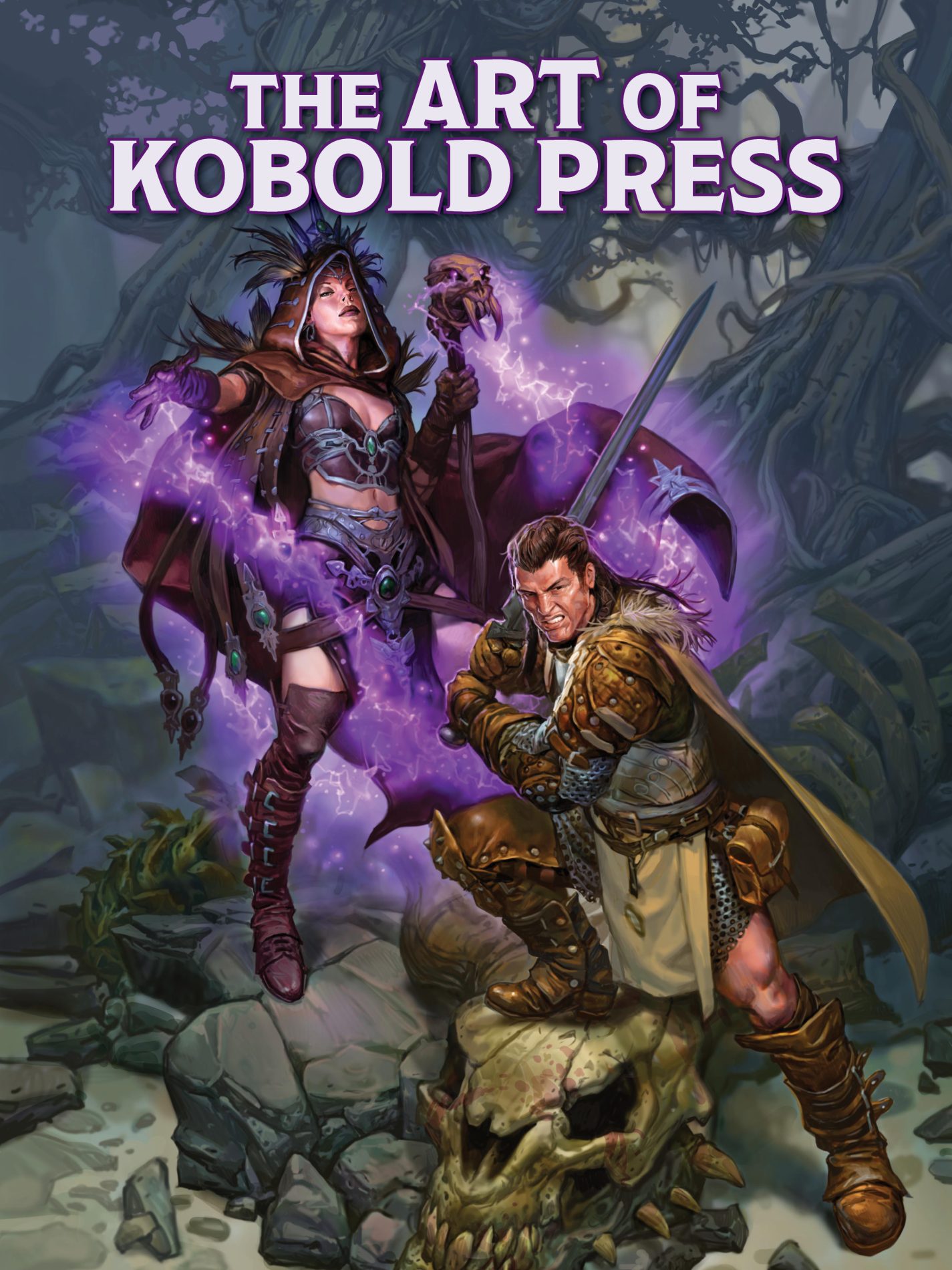
Kobold Press sent me a review copy of The Art of Kobold Press, a book showcasing the artwork used by the company over the course of its lifespan. That gives me the perfect opportunity to recall my connection to RPG art over the years. I was really fortunate to play RPGs in an era when some amazing artists were first defining the look of fantasy roleplaying.
When I started reading comics, I developed the ability to pick up on specific artists that I enjoyed, and could recognize their work before I even looked at the credits in the comics. This translated into my growing hobby of RPGs. The more I looked at the covers of various Dungeons & Dragons products, or the covers of Dragon Magazine, the more I saw details that would define an artist in my mind. I am definitely of the generation for whom Larry Elmore defined the Dragonlance saga with his art, and Keith Parkinson’s Gods of Lankhmar painting is burned into my brain.
The Mind’s Eye
The RPG hobby is predicated on imagination. Many of us love to envision things in our mind’s eye, creating a visual reality only we can see, based on images evoked by words. But the RPG hobby has also been an extremely visual one. That doesn’t rob us of our ability to synthesize our own unique view of the fantasy worlds that we explore, but it gives us a broader palette from which to pull imagery that populates our waking dreams.
I’ve been drawn to RPG art books from the time I first realized they existed. One of the earliest I remember was The Art of Dragonlance, which collected many of the iconic pieces of Dragonlance art that had appeared in the adventures, novels, and sourcebooks up to that time. The Art of Dragon Magazine collected ten years of cover art, which represented a staggering variety of fantasy art. I’ve picked up art books like this for years, including a new version of The Art of Dragon Magazine, this one looking at 30 years of art instead of 10, from the Paizo era of the publication. My copy of Dungeons & Dragons: Art & Arcana is sitting across from me next to cover compilations of DC and Marvel comics, and Star Wars: Propaganda.
The Visual March of Time
Viewing the art a company produces over the years tells a story, and anchors the progression of time. But most of these art books are, well, books, and they literally tell a story as well as presenting the visual evolution of a game or a company. The Art of Kobold Press is no different in that regard. In addition to pages and pages of art from the company’s publications, there is interspersed commentary about the company and the context of the art being produced.
While it is an interesting look at the company’s art over time, it’s not an exhaustive treatment of the company’s history. You can glean a lot from it, but the purpose isn’t to discuss the pioneering of crowdfunded RPG projects before the rise of Kickstarter, starting with Open Design, for example. For the art that is reproduced, the earliest Open Design projects account for much of the page count, moving fairly quickly into the Pathfinder era products and the covers of Kobold Quarterly, which already shows that Kobold Press was in step with industry artwork and keeping up with the high end of fantasy art standards.
The bulk of the volume is dedicated to the 2014 SRD era products, especially the art from the Tome of Beasts line of books, the Midgard campaign setting, and the various adventures published at the time. The last third of the book is dedicated to the Tales of the Valiant era of the company, which includes some discussion about standardizing visual elements and decisions about what needs to be front and center to showcase a new product line. It was a happy surprise to see the Riverbank RPG get six pages to showcase the divergent art style of that game, including a beautiful two page spread. Stan!’s artwork for the Necromancer card game also gets a few pages to shine. I was very happy to see the cosmological map from the Labyrinth Worldbook get a page dedicated to it as well.
Looking Forward
The art in the book includes a preview of the art that will appear in the upcoming Player’s Guide 2, including the class artwork for the new(ish) Theurge, Witch, and Vanguard classes. Seeing that art reminded me of something I wish was present in the book, a more explicit discussion of iconic characters in RPG art. It’s something Dungeons & Dragons has largely left behind (if you don’t count characters from other D&D media getting showcased for marketing purposes) since the 3rd edition era, but Kobold Press partially revived the trend in its art orders for Ghosts of Saltmarsh, has used iconic parties in their art for the Scarlet Citadel and Empire of the Ghouls adventures, and has a new set of iconic characters with the class artwork in Tales of the Valiant.
That’s not to say there isn’t any discussion of the decisions behind how the art is produced. Marc Radle, the art director of Kobold Press, provides much of the narrative, with additional insights from others at the company like Wolfgang Baur and Celeste Conowitch, as well as some commentary from game designers and artists related to the projects shown. At worst, it means that there is room for a History of Kobold Press someday in the future, that can dig into that kind of material more thoroughly.
What I appreciate most about a book like this is that it allows me to get back into the habit of putting names to artwork. One thing that is evident in a book like this is that the modern landscape of RPG artwork is much different than my early days in the hobby. When I was first entering the hobby, it was obvious when someone new like Fred Fields, Gerald Brom, or Tony DiTerlizzi began producing art for TSR. There are so many artists represented in this book that I don’t want to do a disservice to any of them by calling out just a few, but that I know who created some of my modern favorites now is something for which I am grateful.