I have so many fond memories, in my 35+ years of tabletop role-playing, of sitting around the table with my gaming buddies . . . tossing dice, laughing when a “1” was rolled and cheering when a natural “20” saved the day. I remember coloring in my first set of dice, frantically flipping through the Player’s Handbook for the perfect spell before my turn came around . . . and debates that started with, “It says right here in the book that . . .”. I also remember trying to figure out what the red, bull-shaped creature, with bat wings, was on the cover of the Monster Manual, being blown away by the artwork of Erol Otus, Jeff Dee, Larry Elmore, and so many other great artists . . . the image of the rust monster still cracks me up . . . so silly looking, yet one of the most terrifying creature’s my fighter every encountered!
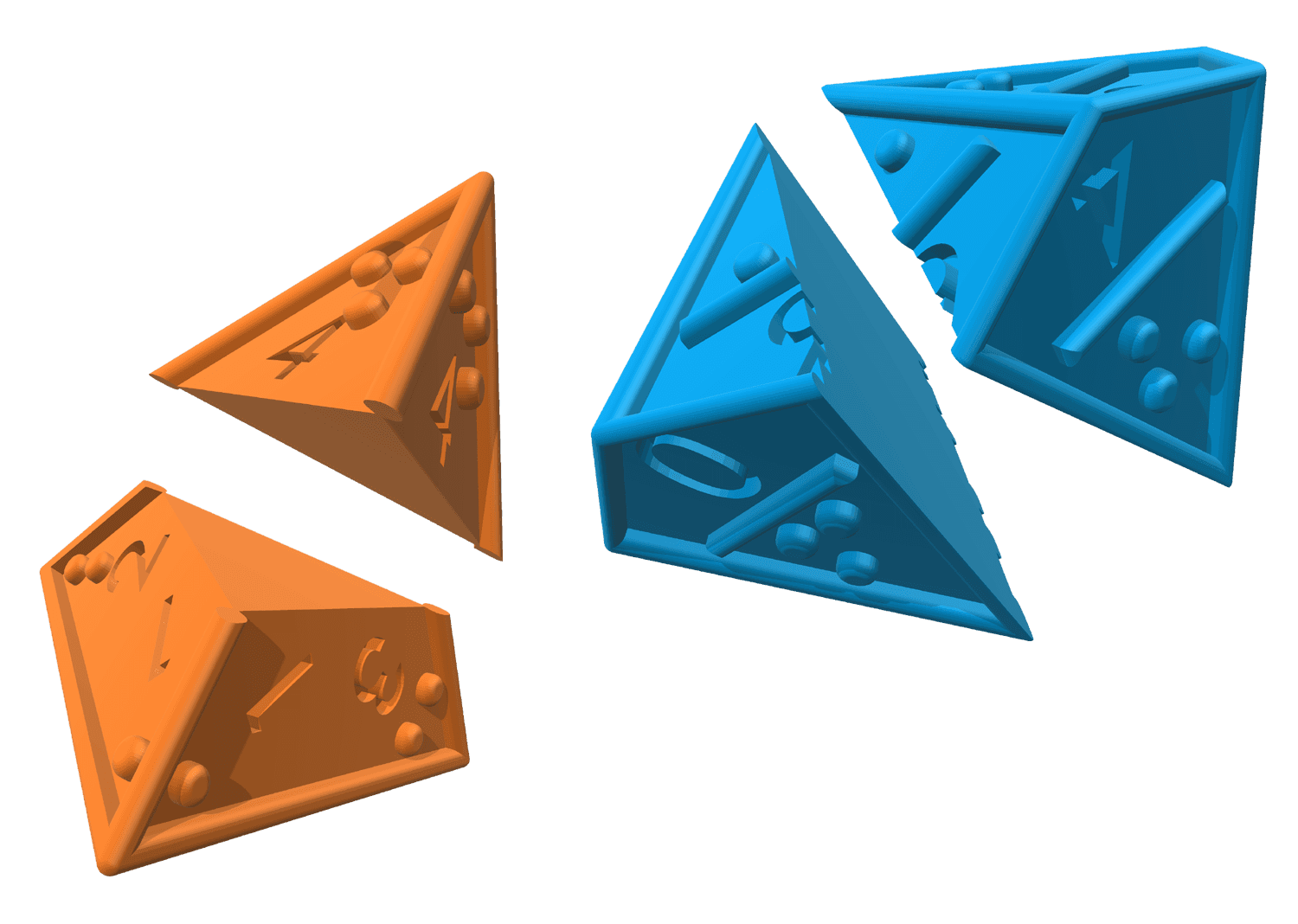
[Image Description: This image depicts 3D renderings of split, braille dice 3D printer models. On the left is an orange d4 split horizontally, on the right is a blue d10 split vertically.]
I went to my first gaming convention in Richmond, VA about 8 years ago . . . and honestly, I wasn’t sure what to expect. I poured over the game signup sheets and saw one that captured my attention . . . Changeling. So, when the time slot came around, I sat down at the table and met “D”, our game master for the session. I had never played a World of Darkness game before and was a little daunted at the details I saw on the character sheet, but D was awesome, and so well-versed in teaching new players that he walked me through the character creation process in no time . . . handed me books and walked me through the spells and abilities. We then proceeded on an incredible adventure, one of the most creative and vivid adventures I’ve ever played in. OK, I know, this sounds like a normal convention gaming session . . . but what you don’t know is that “D” is totally blind.
Over the years, “D” and I became good friends, always looking forward to the con so we could hang out, toss dice and laugh at how my dice repeatedly tried to murder me. Then a few months ago it hit me, “How was “D” so well versed in the gaming material and how did he run such fluid games?”. I reach out to “D” and asked him if I could head to Richmond and chat with him about this. My first question inquired as to how he “read” the game books . . . were there audio books, PDFs run through a screen reader, etc.? You see, there are no braille books and most game PDFs are designed for sighted players and don’t meet all the accessibility criteria to be easily read with screen readers. Now, there are some wonderful pieces of equipment out there, braille readers that work in conjunction with a computer or SD card to translate text into braille and then the braille “pops” up, line by line, on the braille reader . . . basically a living translation machine.

[Image Description: This is a picture of myself and my buddy D, the man that got me started on this project. To the left is an old guy with white hair, blue glasses, and sporting a pride t-shirt with rainbow dice. To the right is D, a handsome person of color wearing a grey t-shirt].
Now, if you’re like me, you might know one or two people, or have seen someone in public who is blind . . . and never really considered the expanse of the scope of visually impaired people–it’s quite large. Additionally, there are many forms of visual impairment, not just blindness. The following is taken directly from an article entitled “Statistical Facts about Blindness in the United States [1]”, by the National Federation of the Blind:
There are several ways to define blindness.
- Many people regard blindness as the inability to see at all or, at best, to discern light from darkness.
- The National Federation of the Blind takes a much broader view. We encourage people to consider themselves as blind if their sight is bad enough–even with corrective lenses–that they must use alternative methods to engage in any activity that persons with normal vision would do using their eyes.
- The United States Bureau of the Census question about “significant vision loss” encompasses both total or near-total blindness and “trouble seeing, even when wearing glasses or contact lenses.”
- The statutory definition of “legally blind” is that central visual acuity must be 20/200 or less in the better eye with the best possible correction or that the visual field must be 20 degrees or less.
- There are no generally accepted definitions for “visually impaired,” “low vision,” or “vision loss.”
As gamers, we like numbers . . . so let’s delve a little deeper to provide a little more perspective:
Prevalence of Visual Disability
The number of non-institutionalized, male or female, ages 16 through 75+, all races, regardless of ethnicity, with all education levels in the United States reported to have a visual disability in 2015.
- Total (all ages): 7,297,100 (2.3%)
- Total (16 to 75+): 6,833,000 (2.7%)
- Women: 3,738,400 (2.87%)
- Men: 3,094,600 (2.53%)
- Age 16 to 64: 3,847,100 (1.9%)
- Age 65 and older: 2,985,900 (6.4%)
(Source: Erickson, W., Lee, C., von Schrader, S. (2017). Disability Statistics from the American Community Survey (ACS). Ithaca, NY: Cornell University Yang-Tan Institute (YTI). Retrieved from Cornell University Disability Statistics website: www.disabilitystatistics.org [2])
I don’t know about you, but for me (personally), I find these numbers staggering . . . 2.3% of our entire population is visually impaired, and over 3.8 million of these people are 16 years old and up. That’s no mere drop in the bucket.
Now that we have some stats to consider, let’s look at how this comes into play since the advent of fantasy role-playing games. Most of us are familiar with D&Dâ„¢ (1974), Empire of the Petal Throneâ„¢ (1974), and Tunnels & Trollsâ„¢ (1975) as the fore fathers of all tabletop RPGs . . . the games that set the stage for all modern tabletop RPGs. Since that time, and this is purely a guess, hundreds and hundreds of tabletop RPGs have been created; from home brew games, the indie press, and the big mass market companies. Yet . . . for all the games created, nothing has been created with the needs of the visually impaired considered. Now, there could be a few braille game books out there . . . I just couldn’t find any references to them and none of the visually impaired gamers I’ve spoken with know of any. So, please understand that I’m simply writing this based on my research and don’t claim to be “all knowing”.
Regardless of 100% historical accuracy, however, what I do know is that in the gaming community, the needs of the visually impaired are not being met . . . and I find that very saddening. Now, I do want to flip the coin and look at things from a designer’s point of view. First, if you were like me, I honestly didn’t realize that the need was there. Secondly, there is the simple matter of cost versus demand.
I recently translated David Black’s The Black Hack RPG into braille, so I understand the process that goes into it. First, I had to teach myself braille, which ended up being one of the most incredible experiences ever! Braille is not a language, it’s a code . . . a beautiful and amazing code. There are two levels of braille, Grade 1 deals with straight, letter-for-letter translation and basic punctuation. Grade 2 braille is much more advanced and delves into contractions and single braille cell representation of complete words (I’m just now starting this journey!). So back to The Black Hack . . . the printed game booklet weighs in around 35+ pages or so and it took me about two hours, as a complete novice, to copy the text to Word, format it, then run it through an open source translation application called Braille Blaster [3]. In this application, I had to go through, line by line, to make sure that the translation was accurate and that the page layouts would make sense to the reader. Setting aside the time it took to learn braille, it only took me a couple of hours to create a braille version of the game. Not bad . . . but then I ran into a new challenge. The 35+ page, 6” by 9” booklet, once translated into braille, turned into an 80 page 8” by 11” book. That’s a lot of pages . . . but not impossible to overcome.
Seeing as that I’m just one person, I decided to send the game PDF to a non-profit agency that specializes in doing exactly what I did . . . just to see if outsourcing the process would be a viable option for game designers. The price quote I received back blew my mind.
- Translation fee (6 hours at $90 per hour) = $540
- Printing Fee for 1 Copy = $45
- Shipping = $10
- Total Cost . . . roughly $600 for a 35+ page booklet using much better software and equipment than I had.
Here’s a short video showing how I got started in the translation process.
Now, my point in sharing this is not to say the company is price gouging–after all, they have utilities, rent, and employees to pay for. The issue is that, depending on the page count of the game book, outlaying hundreds to even thousands of dollars for an unknown ROI is not generally in reach for most companies, especially indie designers.
The question now becomes, “How can game designers also incorporate the needs of the visually impaired into the design process?” It’s a fair question, but one that with some ingenuity we’ll eventually figure out.
This article is not about the project I started, but I do want to share what I’ve done so far, which has since gained momentum that is hard to keep up with. You see, most game designers, once they realize the need, genuinely want to help . . . mainly because gamers are, in general, awesome people who love the hobby and want to share it with everyone they can.
So here’s what I’ve done:
- I reached out to several visually impaired gamers to get their feedback on things such as braille books, existing technology, and what specific things they struggle with the most.
- I taught myself braille–it’s surprisingly easy to pick up on and I promise you that once you start learning, you’ll be fascinated and as obsessed with it as I am!
- I realized that getting print houses with the proper printers to print the translations was out of the question. So I raised money and purchased a braille embossing printer, and now that same $40 print of the Black Hat (mentioned above) costs me about $1.75 to print. Now I can print things at cost and get them into the hands of visually impaired players.
- I reached out to several blind gamers, proficient in braille, and asked them if they would be my proof readers/editors for the braille translation process.
- I designed braille dice in photoshop, then hired a Shapeways designer to create 3D models that can be purchased on Shapeways (at cost) or downloaded for free for people with access to 3D printers.
- I network, network, network, then do a little more networking to find like-minded people who embrace the quest. I have made some amazing friends in the gaming industry just by reaching out and each one is fully on board with getting their games translated into braille and having fully accessible, screen-reader ready, PDF files that can be made available to visually impaired gamers.
- I also just found some new fonts that are designed to help make reading easier for readers who deal with Dyslexia. So basically, with a few extra clicks, I can create PDFs that help Dyslexic gamers on top of blind readers (we’re in the process of testing these fonts currently to see if they work well).
- Lastly, I research (constantly) the different digital technologies available to see how many of these can be leveraged in a way that will help empower independent game play for visually impaired players. As an aside, I’ve spoken with several blind players and simply using audio files at the game table can be a real challenge. So, I’m looking at ways we can work with designers who are experts at designing mobile apps for the visually impaired.
Here’s what it looks like when a veteran, visually impaired gamer get’s his hands on accessible
gaming books, dice, and character sheets for the very first time!
So, where do we go from here? How can you, the reader, get involved? First, help spread the word that there is a real need for the visually impaired and if the gaming industry embraces that need, it could literally open worlds for many people! Next, take some time to learn braille . . . trust me, it’s freaking cool, and once you start, you’ll never want to stop learning. If you are presented with the opportunity, get to know someone who is visually impaired . . . learn about their lives and if they are interested, take them under your wing and share the magic of tabletop gaming with them. Lastly, and this is very important, don’t talk to or treat a visually impaired person any differently than you would a sighted friend. They do the same things we do, they just experience it through touch, sound, and most importantly . . . trust.
I hope you enjoyed this article and found it interesting and inspiring!
~ Jack Berberette – DOTS RPG Project [4]
3 Comments To "Tabletop Gaming and the Visually Impaired"
#1 Comment By griffon8 On November 13, 2017 @ 12:45 pm
Friend of mine when I was in high school was mostly blind. He had no problem playing RPGs but I never knew him to run one. The largest accommodation I knew of for him was while playing SJG’s Illuminati (original version). Since all groups in play are public, that was no problem for him, because we could tell him what was available. For the special cards, which were supposed to be kept private, he has a set with braille holes punched into the cards. Given we are talking about 1985 for this, that was pretty neat.
#2 Comment By Courtney Webb On November 13, 2017 @ 5:23 pm
Thank you for an excellent article. I have wondered about the obstacles faced by people with different disabilities. I myself have moderate memory issues and have trouble with remembering game rules. I GM and one of the things I require is someone at the table who knows the rules and is comfortable with being asked for input and can do so without trying to run the game. It can be challenging for GM and players. I let people know up front and tell them what to expect. There have been occasional issues, however over all it has been pretty good. It is my plan to move to running “society” games where I will likely not have the same table very often and will not know in advance if I have someone to offset my disability. I am a little apprehensive, but I am going to try.
I can only ask that gamers be aware that people with disabilities do play at the tables. Some of us, like myself, have “hidden” disabilities. If someone tells the table of their disability try to be understanding. You’ll meet amazing people who appreciate your attitude and may well change the way you look at a game in positive way.
#3 Comment By Nicholas Stanford On November 16, 2017 @ 9:35 am
I am totally blind, and I am also an avid gamer. I primarily use the Pathfinder system but I also play D&D Fifth Edition. I am excited that you have been working to raise awareness of issues faced by gamers with visual disabilities. Though I appreciate those who utilize braille, my personal preference is to use my computer or smart phone because I feel that I can work faster this way. I have found some reasonably accessible platforms for character sheets and rules references, but DMing is a very real challenge if I were to attempt it from a pre-written adventure path such as the plethora of Pathfinder options available from Paizo. Please keep up the good work, and if there is anything I can contribute that might help I would be thrilled to do so.
As far as character sheets go, most of my Pathfinder games have been on the roll20 gaming site
[5]
This platform is mostly accessible. If I play in person, I use the Fight Club series for iOS, specifically the Fight Club PFRPG/3.5 Edition ap and Fight Club Fifth Edition. These are accessible to a point, but they could be improved. I have written the developer about several simple fixes that could be made but I have received no response. The system I am excited about right now is D&D Beyond
[6]
It is also somewhat accessible and I would like to raise support to campaign for further accessibility improvements, especially when they come out with the smart phone app version.