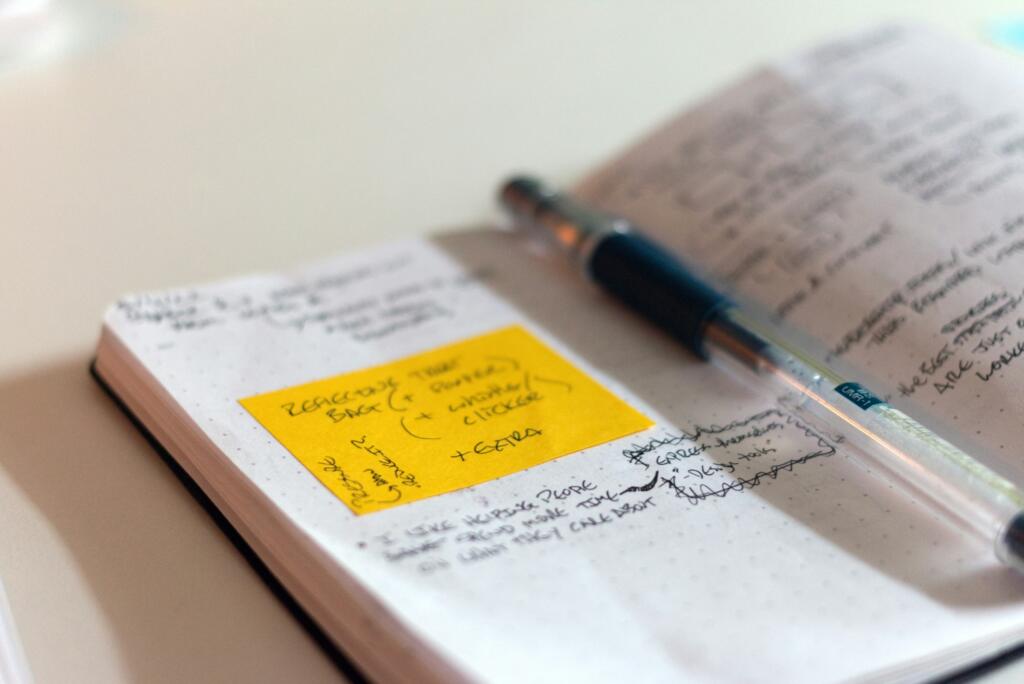
Do you know how to take notes? I’m not talking about transcribing the events at your table verbatim, or jotting down panicked phrases from random sessions that may or may not be in chronological order.
I’m talking about actual, useful, player notes.
For the longest time, I trusted my memory as a player. I relied on my brain for story to remember the events in the order that they happened. Now, either I got older, or I just got more honest with myself. I’ve realized that my memory wasn’t sufficient. In fact, it was pretty dang fallible. I also, unfortunately, realized that even though I’d spent more time in school than not, I didn’t actually know how to take good notes.
So today, let’s dig into how and why we take notes as players, and figure out how we can do it even better.
START HERE
How are notes handled at your table? Does everyone contribute to a collaborative notes document? Is one person the designated record keeper, and thus the single source of truth for everything that transpires in your campaign? Is it the Wild West, with everyone taking their own notes in whatever format they find most useful?
My tables tend to default to that last option. We all take our own notes and reference them at the beginning of our sessions in a recap. But we also never really talked about how we would take notes for our campaigns. Our process developed organically, but I think it’s valuable to discuss it at session zero, because how you take your notes could greatly enhance everyone’s experience at the table.
For example, a campaign based around a team of arcane investigators all contributing their skills and expertise to solving major magical crimes would benefit greatly from a shared notes document. That way everyone can contribute and share information.
Likewise, a back-stabby game about a thieves’ guild almost requires everyone to keep their own notes (and keep them secret)!
Single-source tables, where one person essentially acts as the “board secretary” (very different from a “bored secretary”), can also make gameplay a lot easier on folks who might have attention problems.
But also…imagine that back-stabby game with a table secretary acting as the only one taking notes and doing recaps…what if they’re the traitor?
Deciding who’s taking the notes will help make the other choices later in this article a lot easier to figure out, so make sure it’s one of the first things you discuss as a group.
IN CHARACTER OR OUT?
Let’s say you’re the one taking notes. Maybe not the only one, but definitely one of the ones. The next thing you’ve got to decide is whether or not you’re taking your notes in character, because that will determine what you actually write down.
If your notes are in-character and you’re not in a scene? You’re not writing down what happened there, unless one of the other characters recounts the events later. And at that point, you better be writing down exactly what your character heard.
Only taking your notes in character can lighten the cognitive load for you, since you don’t have to constantly track what everyone else is doing beyond what you would normally do to stay engaged at the table.
Plus, your notes document becomes a kind of in-world artifact as it is essentially your character’s diary.
Taking notes out of character, though, allows you to connect elements from disparate scenes, make observations your character might not realize, and collaborate with the other players on a more meta-level as you try to figure out the BBEG’s doomsday plans.
Regardless of your choice, I highly suggest you stay consistent, because if you flip-flop between the two styles, you’ll find you won’t remember what is and isn’t character knowledge. If you absolutely have to note something that goes against your chosen style, make sure you flag it in your notes as something aberrant.
KNOW YOUR TYPE
Personal story time: right out of grad school, I got a job working for a closed captioning company. I spent most of my days transcribing Discovery Network shows and late-night television. While I’m not as fast as a court stenographer, I can transcribe what I hear in almost real time.
If I reach a flow state, I can let my fingers do their thing while I stay engaged with the story. (But I don’t, because it’s exhausting and feels too much like work.)
The Stenographer type of note taker does this to some degree, either in structured paragraphs or multiple bullet points. They go deep, and they go detailed.
The Mind Mapper, on the other hand, focuses on tiny snippets, grazing on the events of the session like a hungry person going to town on the appetizer table at a fancy party.
Mind Mappers are also more visual, preferring non-linear note-taking. (And often coming off like Charlie Day in that one Always Sunny gif about conspiracy theories.
Lastly, there’s the All Vibes note taker, who somehow manages to grab a name here, a phrase there, a good quote, and maybe the stats of a magic item, but can still look at those crumbs of data and recount exactly what happened in every session.
In truth, we’re all probably a little bit of each, but knowing where you lean helps you figure out the next bit.
PICK YOUR MEDIUM
Once you know your style, you’ll know the medium that works best for you: physical or digital.
For example, nine times out of ten Stenographers will type faster than they write, and a Mind Mapper might prefer paper.
Each medium has its pros and cons. Physical notebooks are versatile and usually cheap (unless you go overboard).
Digital, meanwhile, allows you to share, search, and back up your notes a lot more easily.
There are also plenty of apps available to you, both free and paid. Phil and I have each talked a lot about Obsidian (here [1] and here [2]), and there’s always OneNote and Google Docs if that’s your jam, just to name a very few.
ACTUALLY TAKING NOTES
All of that out of the way, you’re ready to actually start writing things down.
Cool.
What do you write down? How do you actually note?
If you want to get real fancy with your notes, I highly recommend looking at YouTube channels devoted to students and studying tips. There’s a lot of really cool mindsets and frameworks you can practice that will help you take in, note, and process information like a pro. (And on the plus side, the skills transfer over into your life as a student or someone working in an office or corporate setting.)
However, if, like me, you don’t have time to rewire your brain, then here’s a solid starting point: The Five Ws (+ extras).
In my article on GM Prep in Obsidian, I talk about my “Five Ps”: Plot, Persona, Places, Props, and Procedures (rules). That helps my GM brain organize things, but when I’m on the other side of the screen, I find it easier to think like a reporter:
- Who – Note important NPCs, the ones that have names, or the mysterious nameless ones that your GM keeps describing. Get more than just their name if you can. Context matters. Writing down Delilah won’t tell you much, but writing down “Delilah, New York City, recently broke up with the bard from her hometown” tells you plenty.
- What – These are goals. What people (PCs or NPCs) are trying to do. Noting these things will help you get back into the story after you’ve been gone for a week or a month or three. Think of it as your quest log, if that’s helpful to you.
- Where – Locations you’ve been, places you’re going, spots where big stuff went down.
- When – If any information is time-sensitive, you should note when it’s going to expire.
- Why – Motivations, again yours or NPCs. These are different than goals. Your whole party might have the goal of “Getting to San Francisco,” but each of you will likely have different reasons for making the trip. Noting down motivations helps you get back into character faster and stay there longer.
- How – You overcame the encounter! How’d you do it? Conversely, you failed to overcome the encounter. What did you already try? I’m not talking about results on the die. I’m talking about the actions you took. The important ones. The ones with consequences.
- Level Ups – This one isn’t so much an in-the-moment item, more so an in-between-the-moments note. Whenever you level up, or advance your character, I highly recommend noting what choices you made at that level. Nothing is worse than having to reverse engineer a 15th-level character to figure out when you forgot to take a feat or where you got that +2 to your reflex save.
Now, I’m obviously a note nerd, but I firmly believe taking notes will help you stay engaged with the game and make it easier for you to get back into the story and into character between breaks.
What are some of your favorite note-taking tips and tricks? Leave them in the comments. (And let me know if you’d play in that back-stabby game with the (maybe) less-than-truthful single-source notetaker. It would require the right table, but it could be hella fun.)