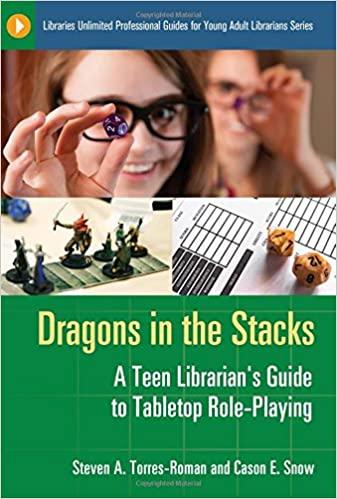
 At Gencon 2015, a serendipitous meeting led me to spending some time talking to Steven Torres-Roman and talking about a book he worked on called Dragons in the Stacks — A teen Librarian’s Guide to Tabletop Role-playing. Steven gave me a copy to look over and I decided to review it for the Stew. Having spent time in my past working at public libraries, it was interesting to talk to Steven about the impact of tabletop role-playing games and their use in libraries. I’ve always been a fan of libraries and using them in my gaming life. Whether it is including gaming books in the collections, using the reservable rooms as a neutral space for game play, or librarians making gaming a key point of programming, there are a ton of ways libraries can intersect with gaming. So, to hear that Steven and Cason E. Snow wrote an extensive book on incorporating gaming and libraries, it made me quite happy. Here is a short review of Dragons in the stacks that might make you jump at the chance to start gaming at your local library.
What Is It
Primarily, Dragons in the Stacks is a book aimed at teen librarians to help them develop collections of gaming materials and programs to support gaming. In the five chapters, it covers a brief introduction to the history of tabletop RPGS (very much like a compressed Designers and Dragons), a primer on developing a robust RPG collection from free and keystone RPG lines, the ways to use it at a library, how to develop programming around RPGS, and finally the bulk of the book (chapter 5, over 100 pages) is a rundown of various games and reviews of them. The reviews are based on criteria like complexity, support, popularity, versatility, how well they emulate a given genre, etc. and are all categories are ranked from 1 to 5.
So wait, why is this useful to me as a Game Master? Well, in much the same way that Designers and Dragons is a great read to make you think about other games and understand the gaming landscape and its roots, Dragons in the Stacks provides a well researched and condensed overview of tabletop gaming. Since it is aimed at Teen librarians, who may or may not be familiar with gaming but would want a good overview, reading Dragons in the Stacks provides an excellent way for a new player or a new Game Master to quickly come to speed on multiple types of gaming going on right now. The glossary section provides what feels like a scaled down, broadly focused version of the stew’s own glossary of RPG terms. This glossary section is aimed at describing things to people who have never played. Things like Point Buy Character Creation provides a short paragraph description that would fill in a new gamer or Game Master enough to give them a perspective on how it would work if their current game didn’t describe it.
The history of tabletop role-playing games chapter is also well researched and provides a very brief, yet complete, overview of gaming through the years. This in itself is important as new gamers have fewer connections to the roots of gaming. As the roots of the game industry get farther from the present, it’s important to be able to help new gamers get a feel for what was and how it shaped what currently is. It is important to be able to look at the big picture and see the trends that cause a change in the gaming industry, and Dragons in the Stacks provides a great overview of the history and present of the gaming industry, as well as good guesses at what the future might hold.
The selection and collection development chapters are less likely to be immediately relevant to most non-librarian gamers, but much of the content of the chapter deals with what are currently the big names in gaming and where you can find free rules to try out various games. The cataloging chapter is an interesting read, but likely of little direct relevance if you aren’t a librarian. In contrast to the cataloging chapter, the programming chapter is full of advice that a new Game Master could cherry pick and modify to their own use. The book even references Gnome Stew as a source for game mastering advice and talks about Never Unprepared and Odyssey.
The biggest section is the Guide To Games, and it is a great overview for many games that are out there. It covers many games that are older as well and may not be as popular. This is a strength fo the book, as it may lead you to new games that aren’t as well known but might be right up your alley. While this section doesn’t cover every game ever, it is a good overview and provides excellent, quick, insight into how a game runs, the mechanics it uses, and how much time/effort/resources it would take to get into that game with your group.
Final Thoughts/Overview
Dragons in the Stacks was probably not intended for the average gamer or Game Master, but it is a good resource for those looking to fill in gaps about gaming or help introduce others to gaming. The pricetag through amazon [1] ($45.00) is more in line with academic book prices, but there are many sellers who have it for a little less. One of the nice things about how this is written and who it is aimed at is that it is intended for librarians. So, if you want access to the advice and interesting read, but can’t justify the $45.00 for your personal collection, here is what you do:
- Walk into your local library and ask who handles collection development.
- Talk to them or the teen librarian and ask if you can request they acquire that book for the collection.
- Optional: Suggest that you’d be willing to help run games or volunteer if they find the material of use.
They may order it out of the curiosity bred by an interested patron, and that may spark the librarians to start building up a tabletop role-playing section if they don’t already have it. If you help them run games, then you will benefit by not only having this book to read and helping to build up an RPG collection in your local library, but you’ll also be seeding gamers for the future who will carry on and keep the hobby strong.
Dragons in the Stacks is a bit of an odd fit for most gamers who are already in the know, but it tackles the hobby from a slightly different perspective. It’s a great overview and a great primer to gaming for the uninitiated, and it might be worth it to highlight and hand to potential new gamers to get them up to speed.
You can paw through a few pages of Dragons in the Stacks on google books and form an opinion for yourself, but I would definitely recommend it as something to check out and see about getting in the hands of your local library.
Interview
As an added bonus, I shot a few quick questions to Steve and Cason, who obliged me with some answers about the creation of the book.
What prompted you to undertake writing this book?
- Steve:
As I recall, it was kind of a perfect storm. I seem to remember that Cason was working toward tenure at the time, and had already started publishing articles and presenting at conferences. I had just published a book on science fiction for librarians, Read On … Science Fiction: Reading Lists for Every Taste, and it occurred to me that my publisher, ABC-CLIO, might be interested in a book like this.At that time, I already had been running RPGs for local youth for years. I had to host the programs in the community for the first few years–because of lingering memories of the 1980s Satanic Panic, the library director was initially reluctant to host those programs at the library, which was too bad. I knew that RPGs were a fantastic hobby, and that they positively reinforced a lot of educational skills and developmental traits in young players.For example, RPGs reinforce basic math skills and communicate a sense of story structure and narrativity. They promote literacy by encouraging players to read fiction in the same genres as the games they play. Players often become more social as they interact and form friendships with other players, and gain a sense of agency as they put their wild plans into action. And if plans go awry, RPGs provide a safe virtual environment for experiencing consequences: if a dragon eats the adventuring party, the players can roll up new characters and have more adventures! Perhaps most importantly, playing RPGs practically teach creativity and require players to engage in “outside the box” thinking.Given all of these benefits, I felt certain that RPGs would be a boon to both library programs and their participating teens. I wanted to spread the word to other librarians (RPG evangelism?), to see more gamers in libraries and RPGs in library collections.On a final positive note, after seeing the popularity of the RPG program, the benefits to the teens, and the support of the teens’ parents, the director later changed her mind about running RPGs in the library, and Adventure @ Your Library now meets two to three times each month!
- Cason:
For me it was a personal mission as well. I remember finding the 1st edition Dungeons and Dragon core book in my public library, in the juvenile section, and spending  many days reading them until I saved enough allowance to purchase them myself. One day the books disappeared, and never returned to the shelves. At this time I was a neophyte gamer and met other gamers only through happenstance at school. It all had to kept fairly quiet due to the Satanic Panic gripping the nation at the time.Now that the Panic has, mostly, left I think it is high time that games make a return to libraries. I don’t have the same experience that Steve does of running games for teens, so all I have is anecdotal and personal experience, but gaming, for me, really broadened my horizons and they continue to do so. These games promote teamwork and group problem solving, even if that problem is inter group conflict. InterpersonalÂ
communication and thinking on your feet are also important skills that are developed and improved through role playing. Basic math skills, including probability, and literacy are emphasized in these games. These games can also allow teens to experiment with different solutions to problems and deal with the consequences in a safe environment. Playing these games have, in part, made me the person I am today, and I want the teens of today to be able to reap the same benefits that I did from these games.
What was your thought process when developing the criteria for reviewing various games? How did you choose which RPGs to focus on?
- Steve:
We wanted to primarily focus on current, in-print games that were age-appropriate. Beyond that, we tried to be as inclusive as possible: games that varied in rules intensity, genre, settings, styles of play, indie games, OSR games, games from big publishers–you name it. Our aim was to present each game fairly and talk about its appeal factors–what kind of game it was, what it had to offer, what it did well, and why a person might want to run or play that game. - Cason:
Our first criterion was the game had to be in print (at the time of writing), and generally for a teen audience. We also tried to cover a variety of genres and game styles out there. So we reviewed games that are very rules intensive, rules light, setting focused, universal, etc. Of course due to our timing of the book we could not review the published version, i.e. Player’s Handbook, Dungeon Master’s Guide, and Monster Manual, of Dungeons and Dragons, 5th edition, so we made due reviewing the Starter Set, but D&D being seminal to the hobby we could not just leave it out.
How well received has Dragons in the Stacks been amongst the intended audience of Teen Librarians?
- Steve:
We’ve been very pleased with the generally positive reviews that we’ve received so far, in Teacher Librarian (Dec. 2014), Voice of Youth Advocates (1 April 2015), School Library Journal (1 April 2015), and Midwest Book Review (Dec. 2014).In addition, I’ve had librarians from several other libraries send me email, either encouraging me and telling me about their RPG programs, or asking me for advice on running programs at their libraries, so that’s fantastic. I’ve also had the opportunity to teach a graduate-level class on the use of RPGs in school and library programming at Northern Illinois University. And of course, thanks to EN World (http://www.enworld.org/ [2], http://www.ennie-awards.com/blog/ [3]) and Annah Madriñan, the 2015 ENnie Judges’ Spotlight Award promotes and broadens awareness of the book and opens up new opportunities to reach libraries, librarians, and gamers. - Cason:
This one Steve could probably field better, but we have had positive reviews in library literature, the most relevant being a review in the April 2015 issue of VOYA (Voice of Youth Advocates), and the April issue of School Library Journal.
What would you say is the most useful thing that a non-librarian Game Master can get out of this book?
- Steve:
I think that the book is a good, all-around reference source, provides a solid overview of a diverse range of games, and offers the collective advice of two veteran RPG gamers and game masters. - Cason:
Our advice on running a group would be useful to a novice GM whether or not they are a librarian. Other GMs can find our reviews useful as we include genre tags which could lead to a serendipitous discovery of a new game.
How could a Game Master help their local library develop a gaming program or collection?
- Steve:
If their local library has programs for teens, then gamers and GMs can take the initiative and mention the book to the librarians–this might spark an interest, and at the very least opens a dialog. Gamers and GMs might also mention the book to any local game stores, as the store may want to partner with the local library and run games for patrons, which could benefit the library, its patrons, and the game store. And of course, GMs can volunteer their time to run RPGs at the library (be sure to ask the local librarians about their programming criteria).I would also prepare to respond thoughtfully and respectfully to any concerns stemming from the negative publicity of the 1980s, because sadly that’s still a thing. One of the best sources you can use to educate yourself in RPG advocacy is the website The Escapist: The Reality of Fantasy Games (http://www.theescapist.com/ [4]). - Cason:
First, mention the book to the teen librarian at the local library and see if they would be interested in starting up a gaming group. Second suggest games that would fit in with the collections on the shelves in the library, you could even talk to the teen librarian and ask what is popular in the library and suggest games based on that. Ideally these games should supplement and support the existing collection.
7 Comments To "Dragons In The Stacks"
#1 Comment By black campbell On September 14, 2015 @ 9:25 am
Way, way, WAY back in the late ’70s, our small town library was very good about giving us early RPG players a place to play, and a way to meet other folks who played (via the ol’ flyer on the bulletin board…do they even do that anywhere, anymore..?)
#2 Comment By John Arcadian On September 14, 2015 @ 9:35 am
Absolutely. Community rooms can always be used and my local branch of the Columbus library said I could run a D&D program on my own there.
Unfortunately, the city library system has a strict policy of teen programs only focusing on college and job prep. That broke my library-loving heart, as I spent many hours at the library as a teen in various programs, but none of them college prep or job related.
The other library systems here have been open to my inquiries about starting up library sponsored teen-gaming programs though, and some even do this.
http://www.thisweeknews.com/content/stories/worthington/news/2014/08/19/library-lines-teen-rpers-play-latest-dd.html [5]
I see running gaming at a library as a great way to keep the community of gamers active and in the public eye.
#3 Comment By Tiorn On September 15, 2015 @ 8:24 pm
John, a friend of mine messaged me on facebook a couple of years ago, wanting ideas for a gaming shop. He really wanted to focus on having tables available for games. I’m not sure exactly where he’s living now, but he was in the Reynoldsburg area for quite awhile. Unfortunately, it seems that he has dropped the ball on his idea and I haven’t heard any more about it. Wish he had went through with it, because I probably would have made the ~70 mile trip to participate. But, oh well. 🙂
#4 Comment By John Arcadian On September 16, 2015 @ 5:22 am
Gaming stores are always a gamble. The margins are low and the way you get constant income isn’t what most people who run gaming stores want to be doing (magic, pokemon, and whatever CCG is popular with the young kids). Columbus is a good place for it though. There is a huge geek community here, and a decent number of gaming/comic shops. We’re not quite nerd central, like Seattle is getting to be, but it’s a really cool midwest city to be geeky in it.
#5 Comment By Mike Ge On September 16, 2015 @ 10:11 am
This is great. I am good friends with a librarian. I am going to pass this along to him. He has been working hard to incorporate comics and gaming into his branch. Thanks for the article.
#6 Comment By Scott Martin On September 16, 2015 @ 10:33 am
I excitedly shared this with a local librarian friend who organizes many events, including Bookwyrm [6], where I ran Kingdom last year.
#7 Comment By oliver@ojogames On October 12, 2015 @ 10:09 am
This is a great idea – somewhat new to me, but I can appreciate the precedent for library gaming. I am going to approach my college library and see if they would be interested. I also tweeted about it on my OJOGames account.
What impressed me most about this article was Steve’s response to the question “why did you take this project on in the first place”. I agree with him that there are may developmental advantages to gaming for young people. This is the main reason I set out to create my Storytime Chimera family RPG: http://ojogames.com/storytime-chimera/ [7]
It is only now starting to dawn on me how much of an impact narrative competence makes in our lives. The ability to explain things in terms of a coherent narrative, and from an understandable point of view is essential to almost every human activity. This skill is fundamental to human socialization. There is no better way to gamify the study of narrative than tabletop RPG, in my opinion. In a digital age where the internet and social media offer us a puree of narrative bits with no true cohesion, it is essential that we provide our youth with opportunities to engage in storytelling.